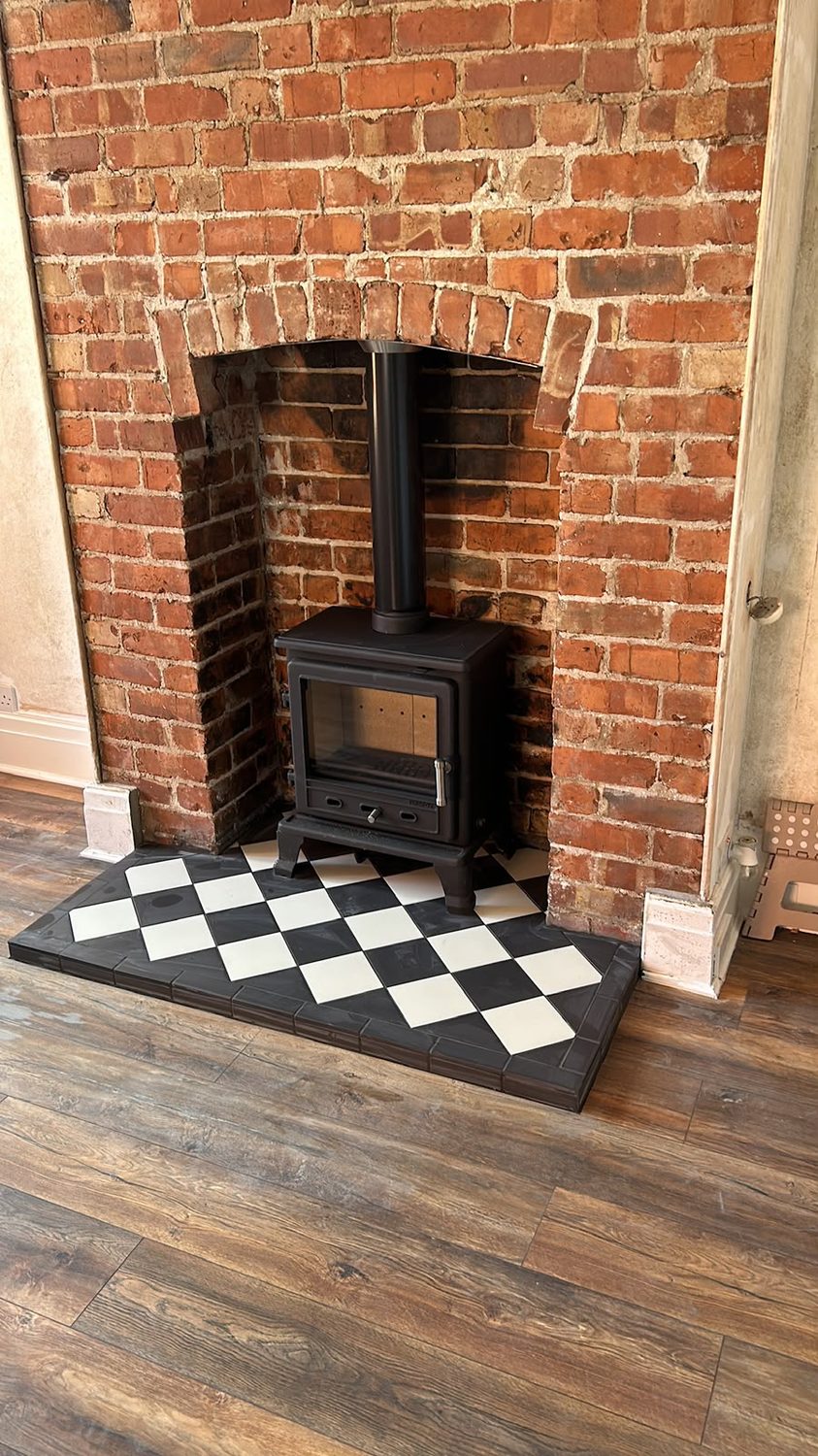
Can you restore an original Victorian tiled hearth?
Sometimes, and it is always worth a look before replacing it. Original hearth tiles can often be cleaned back, damaged individual tiles replaced with reclaimed matches and the bedding repaired. Where too many are cracked or the hearth has been broken up for a gas fire, a new chequer or encaustic hearth laid in the traditional pattern gets you the same look with none of the compromises.
What is an encaustic tile?
A tile where the pattern is made from different coloured clays running through the body of the tile rather than printed on the surface, which is why Victorian originals still show their pattern after a century of feet on them. Modern reproductions are made the same way and are what we usually lay for a period hearth, because a printed lookalike wears through.
Will the plastering be included?
Yes, on any installation we carry out. The breast is patched or skimmed back to a finish ready for you to decorate, and the skirting is refitted. What we do not do is paint it, because fresh plaster needs time to dry out properly first and rushing that ruins the finish. We will tell you how long to leave it for your particular job.
How long before we can decorate?
For a patch repair, usually a few days. For a full skim on a breast, allow a couple of weeks and wait until the plaster has gone a consistent pale colour all over with no darker damp patches. The first coat should be a thinned mist coat rather than full strength paint, or it will not key and will peel later.
Do you do tiling work without an installation?
Yes. Retiling a hearth, replacing a broken chequer, tiling a chamber or making good a breast after somebody else has been are all jobs we take on their own. They are smaller pieces of work and they get the same set out and the same care as they would as part of a full install.
Can you match tiles to an existing floor?
Often. Reclaimed and reproduction Victorian tiles are widely available in the common patterns and colours, and a hearth does not have to match a floor exactly to look right, it has to relate to it. We will bring options to the room and look at them against what you have in daylight before ordering anything.